Clinical examination
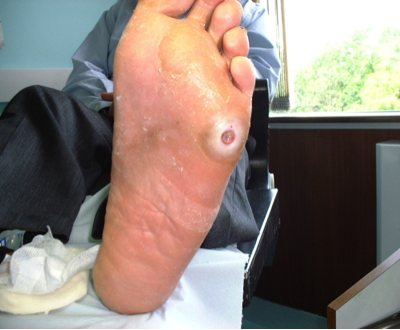
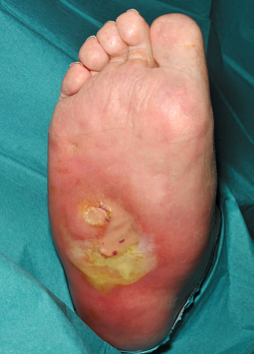
This is one of the most important aspect of diagnosing ulcer infection. Clinical examination will help determine whether antibiotics are required and whether urgent surgical review should be sought. Ulcer infection produces cellulitis of the soft tissues, with erythema, warmth, oedema, purulent discharge, odour, increased exudate, and tenderness.
However, the classical features of infection may be diminished in patients with diabetes due to vasculopathy. In moderate infection lymphangitis may be present, in which linear erythematous streaking may be seen due to infection spreading via lymphatic vessels.
There may be changes in wound base characteristics from pink granulation tissue to a grey/yellow appearance with delayed or deteriorating healing despite adequate circulation and pressure off-loading. Inadequate assessment of clinical features at this point can lead to deeper and more invasive infection setting in.
The Infectious Disease Society of America (IDSA) has produced a grading system for clinicians, characterising the key features of infection, from mild to severe (table 2). This grading allows clinicians to decide on antibiotic type and formulation, and can also assist with decisions about hospital admission.
Table 2: Clinical characteristics of infection and severity based on definitions from the infectious Disease Society of America (2)